

Sonic Heights, Permeable Horizons: An Essay by Lucie Nezri
A poetic review of the ‘Listening Room’ at Zone2Source, tracing its shifting acoustics and the quiet negotiations between site, sound, and attention.



On an auspicious Friday 13, composer and artist lucie nezri steps into Sonic Acts’ Listening Room at Zone2Source. In the octophonic surround-sound exhibition, works by Espen Sommer Eide, Signe Lidén, Clara de Asís, and BJ Nilsen unfold within porous acoustics, where birdsong and distant engines drift through the winter air.
This essay is part of the Biennial Report, a series of commissioned articles offering insight into Sonic Acts Biennial 2026, Melted for Love, written by cultural journalists, researchers, and critics.
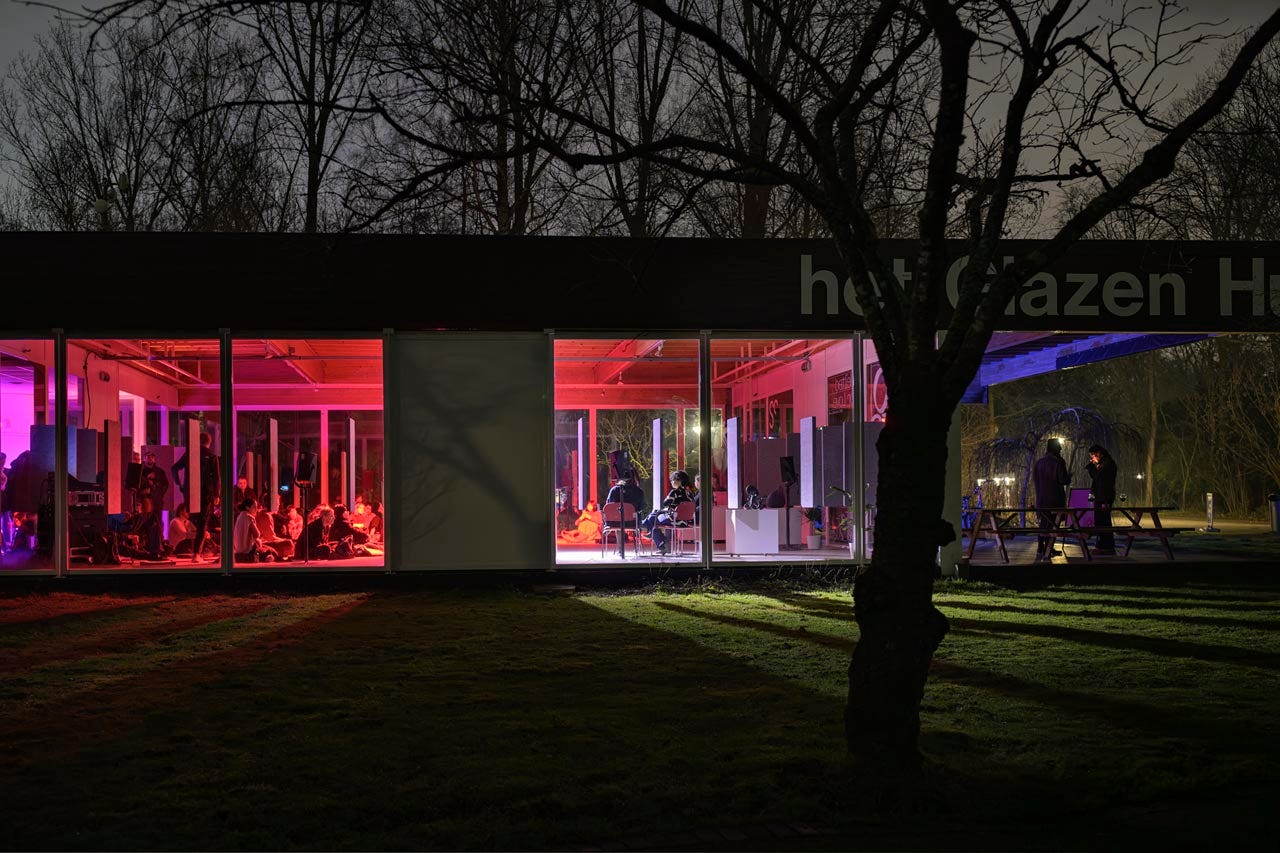
Sonic Acts’ Listening Room showcases fixed soundworks on an 8.2 surround system, housed in Het Glazen Huis, the glass pavilion of Amstelpark-based gallery Zone2Source. Running from Friday to Sunday, with three sessions daily across nine distinct programmes or ‘rooms’, some of the featured artists previously participated in the Sonic Acts Spatial Sound Residency in Rotterdam, while others present pre-existing pieces. Either way, the curation is innovative, yet far from the clichés of acousmatic or acousmonium-inspired musique concrète. So often spatialised sound composition risks collapsing into spectacle: granular AI-designed stochastic 32-channel explosions ricocheting from speaker to speaker and other ‘alpha’ aesthetics – which, don’t get me wrong, I appreciate once in a while – yet which can so easily default to bombast over nuance.
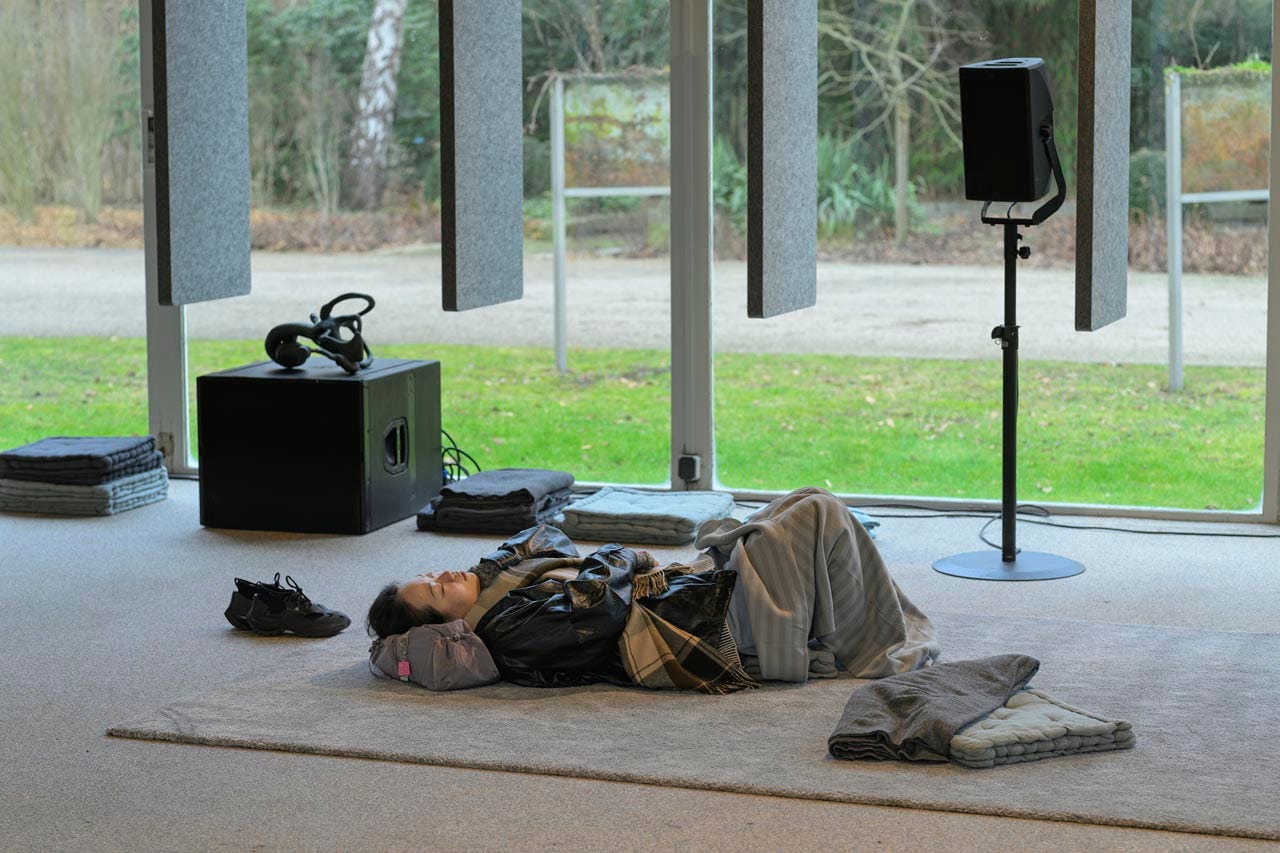
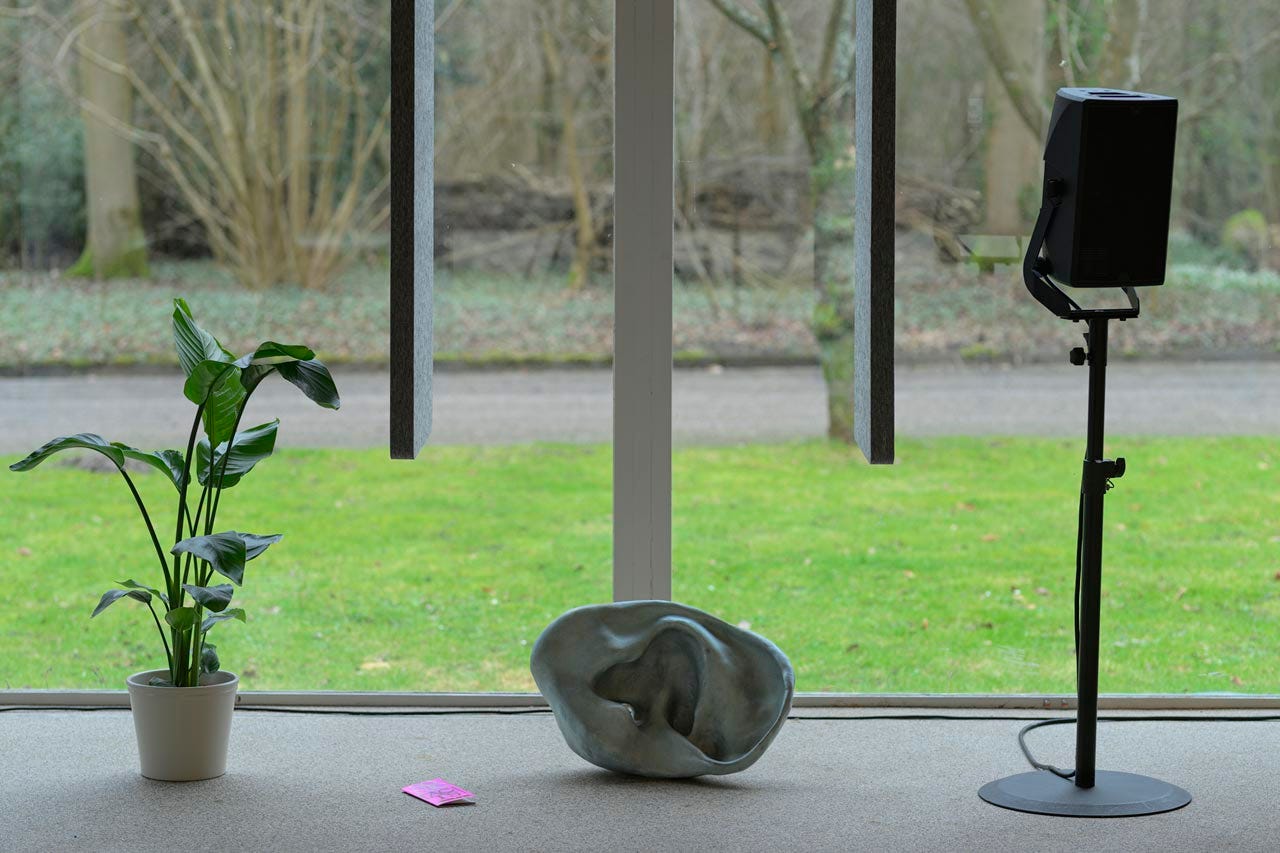
Instead, upon entering the Listening Room, one is greeted by a cosy, intimate atmosphere. Listeners are kindly asked to remove their shoes. A risky choice, you might say, but on that merciful Friday 13, feet were heavenly and their scent non-existent. Guests may sit or lie down on equally heavenly carpets, surrounded by beautifully strange ear sculptures by Ragnhild May. Showcased under the title Coming Out the Ear, the sculptures depict enlarged outer ears and casts of inner ears (cochleae). Inviting contemplation of listening as a spatial and material condition, May’s ears operate as both organ and object – simultaneously monumental and haptic: a threshold between bodies and environments.
Offering a situation somewhere between a concert hall and a sound installation, Zone2Source is far from sonically neutral. Its wooden ceilings, concrete floor with carpets, and, most importantly, glass windows opening onto the park all shape the acoustics. Sound-absorbing panels may be present, yet one still hears cars on the nearby highway, birds chirping, planes overhead, gusts of wind, and joggers passing by. During my visit, the civilised bleating of goats – residents of Amstelpark’s kinderboerderij (petting zoo) – could even be heard politely finishing their leafy lunch just 20 meters from Het Glazen Huis.
I was so absorbed in sensing my surroundings that I felt slightly disoriented by the rather abrupt beginning of the first piece of the programme: Vertical Studies: Archival Spirals (2017) by Espen Sommer Eide and Signe Lidén. Stemming from an ongoing collaboration between the two sound artists, the work investigates how wind, altitude, and winter temperatures shape the transmission of sound. Drawing from experiments and field recordings gathered across northern Norway and Russia – in Nikel, Sint Jansklooster, Fjell, Bakkehavn, Østensjøvannet, and Mandø – the project explores the idea of sorting an archive by height. Vertical Studies: Archival Spirals traces a trajectory through these materials, imagining bodies as antennae extending from the ground into the outer atmosphere.
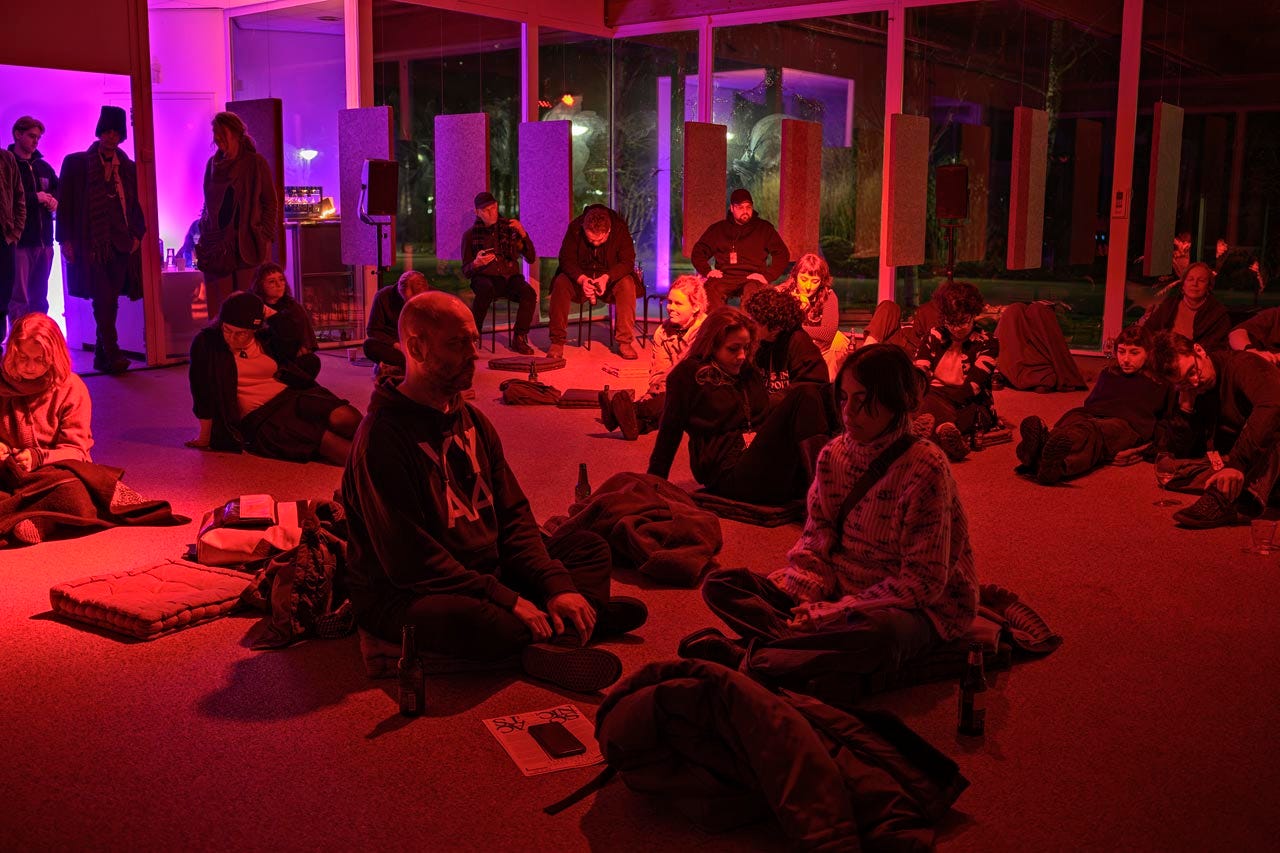
What struck me most was the tension between the space suggested by the work and the one I physically inhabited. As a listener, the work seemed to invite a liminal state, suspended between vast, reverberant expanses conjured through stacked ‘big sounds’, their wind-like movements sweeping restlessly across the speakers. These momentous, almost cosmic forms stood in stark contrast to the scenery of Amstelpark: windless, still, and carefully manicured. I also enjoyed Vertical Studies for its unexpected harmonic developments and the gradual morphing of bird recordings into synthetic emulations, unfolding in circular motions. It felt as though each sound projected from a new speaker introduced further transformation, heightening the ambiguity between the original recordings and their artificial counterparts – and perhaps, in doing so, subtly amplifying Amstelpark’s own artificial landscape.
After a short silence, we moved on to Clara de Asís’ Infinity This Time (2026). Developed during her Sonic Acts Spatial Sound Residency, de Asís’ piece explores subtle interactions between bells, analogue electronics, and spatial acoustics. Shaped by microtonal shifts and resonant overlaps, the composition cultivates a heightened state of listening, where sound becomes a tool for sensing time, attention, and perceptual focus.
As in much of de Asís’ recent work, power emerges through restraint: a delicate, precise minimalism coupled with real conceptual depth. Rather than simply ‘moving sounds around’, de Asís’ non-dogmatic approach to sound and space operates through diffusion and opposition. These oppositions are not primarily timbral but spatial. Working largely within a mid-to-high frequency range and maintaining an overall restraint in both material and dynamics, the piece allows subtle spatial distinctions to emerge. At times, an FM synthesiser would appear on one side of the room, answered by a more piercing tone elsewhere, with beatings occurring in one’s ears.[1] At other moments, these materials would converge into a single sound, their beating more overtly located at a single point.
Within Infinity This Time, multiple temporalities intertwine – modulation rates, interference patterns, and short resonant pulses – all create a quietly combinatorial logic in which materials merge, separate, and recombine. A clear internal logic guides the piece, even as its form remains spare and exposed. The work feels neither strictly conceptual nor purely process-based, but deliberately suspended between the two. It is, to put it simply, just beautiful. And unlike the previous piece, there was no friction between the work and its setting; the alignment was immersive.
As the sound of the piece gradually thinned and disappeared, it dissolved into the distant low hum of an aeroplane outside, which was also a perfect bridge to the last piece of the programme: BJ Nilsen’s Scalar Towers (2026). Drawing on decades of working with field recording and composition, the artist also composed the piece during his residency at Sonic Acts Spatial Sound Studio. Using recordings from a historic water tower in Radio Kootwijk and a feed silo in Friesland, the work explores vertical acoustics: how sound rises, reverberates, and reshapes space. Created nearly a decade after Vertical Studies, it shares a related methodology of site-based investigation and spatial listening, yet approaches verticality from a different perspective: less atmospheric and archival in scope, and more architectonic and sculptural.
Thanks to the programme’s beautifully shaped curatorial arc, this final piece felt like a synthesis of the two preceding works in its compositional approach, while foregrounding a distinctly digital aesthetic. The first section of Scalar Towers seemed almost like a reversed mirror of de Asís’ piece: immersive through its carefully designed timbral palette and spatial disposition. Low, filtered noise moved in waves that enveloped and blended seamlessly with the acoustics and surroundings of Zone2Source.
The second part of Scalar Towers shifted toward a more additive process, gradually widening the pitch spectrum, which unfolded through subtle asymmetries in spatial placement and sound movement. Layers of synthetic tones and filtered noise accumulated, until they encompassed nearly the entire frequency range. With this expansion, the piece moved into a more pictorial register, evoking desolate (though ambiguous) landscapes of vertical forms, such as the silos, which merged with a digitally expanded sense of what ‘nature’ might become. For instance, Nilsen incorporated recordings of birds, gradually processed and diffused throughout the room until, eventually, their chirping became scattered blips, no longer recognisable. Experiencing this section while gazing out at the park produced a strikingly unsettling effect. The same applied to the final, brief coda: a short chord that seemed to arise from nowhere and resolve nowhere, without clear origin or destination. These subtly nihilistic touches were thoroughly enjoyable.
Overall, the Listening Room leaves a lasting impression and is well worth experiencing firsthand. Sonic Acts offers an inspiring model for presenting sound works beyond the conventional ‘black-box’ concert format. For many, such tightly controlled electronic music settings can feel overly sealed, even constraining to the compositions themselves. The Listening Room instead creates open, flexible conditions in which works are allowed to breathe. Rather than forcing listeners into a seat, the venue accommodates wandering, daydreaming, social exchange, and reflection while sustaining a high degree of attentiveness and engagement.
Lucie Nezri is a composer, artist, and performer born in Hyères, France. Working across composition, tuning theory, musicology, computer science, and occasional choreography, she is drawn to abstraction, simplicity, and ‘not knowing’. Her pieces combine algorithmic, probability-based systems with attentive care for melody and harmony, and often unfold in multiple versions – revisions, reconstructions, and reimaginings that approach a work from shifting perspectives. Nezri holds a Bachelor’s and Master’s degree from the Institute of Sonology at the Royal Conservatory of The Hague. Extending her long-standing practice of creating experimental mixtapes (fascia lata), she founded the independent label dis ce que and runs a Substack under the same name.
[1] Beating refers to the audible pulsation that occurs when two tones of slightly different frequencies are sounded together. The tones alternately reinforce and cancel one another, producing a rhythmic fluctuation in loudness at a rate equal to the difference between their frequencies.
 | A guest post by
|