

Refusal, Recognition, and Reworlding the Digital: Interview with Sondi by Tiiu Meiner
What ghostly inheritances haunt commercial technologies, and how does art uncover them? Read the interview with artist and researcher Sondi, in conversation with Tiiu Meiner.

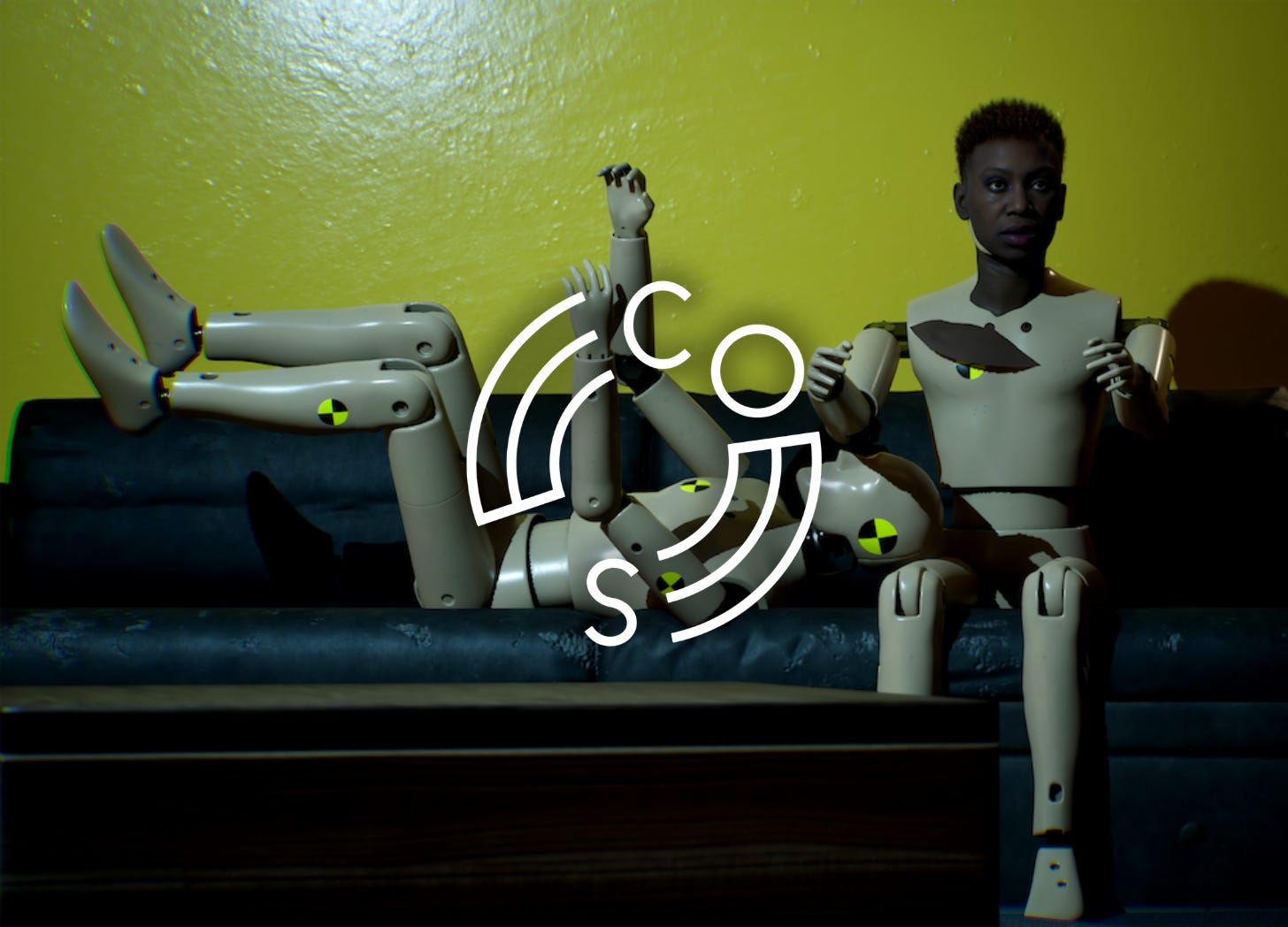
On 19 March at murmur, during the fourth instalment of the concert series Heart Rests Twice – part of the Sonic Acts 2026 Biennial – artist and researcher Sondi will present Non-User Friendly. A newly commissioned audiovisual performance, it reflects on the ecological, political, and cultural realities of AI, featuring dramaturgy and a sound composition by Soraya Lutangu Bonaventure. The performance was developed within the framework of SPRINGS, Sonic Acts’ new commissioning platform designed to support emerging makers on the Dutch art scene. In this interview, originally published in the Biennial Reader, curator and writer Tiiu Meiner speaks to Sondi about rest and resistance, video games as value systems, and imagining alternate realities.
The digital realm did not emerge in isolation. It grew from systems – hierarchies and colonial orders; architectures of surveillance and control, and the extractive economies that have long ordered the world by power and value. The networks and databases that shape our lives today extend those same infrastructures, translating historical patterns of control into new technological forms. Artificial intelligence is only their latest expression: a machine trained on the world as it has been, not as it could be.
This is where Sondi’s work begins. An artist and researcher from Germany, born in Cameroon and based in the Netherlands, she moves across the virtual sphere, video games, and immersive environments. She recognises that the environments we inhabit – both on- and offline – were written by specific people who inscribed their own intentions into the code of reality, while others were left outside its frame. As Octavia E. Butler once said, ‘You have to make your own worlds, you have to write yourself in.’ Sondi takes this literally, finding ways to write herself – and others – into the digital spaces that have inherited centuries of exclusion.
In Mbombo: Dream Echoes (2024), she begins this rewriting through play. The work takes the form of a computer game that rejects the logics of speed, mastery, and accumulation typical of mainstream design. Progress depends not on competition, but on slowness, care, and attention. The player moves by walking, resting, and dreaming, learning that rest itself can be a form of resistance. Through this gentle inversion, Mbombo proposes a different value system: one where imagination and rest are not escapes from reality, but means of remaking it.
Her most recent project, Non-User-Friendly (2025), shifts the focus from narrative to infrastructure. Developed within the framework of SPRINGS, Sonic Acts’ new commissioning platform designed to support emerging makers on the Dutch art scene, Non-User-Friendly will be presented during the 2026 Biennial. Unfolding as a live performance, it confronts the racial, ecological, and political foundations of artificial intelligence; the invisible networks of data, minerals, and human labour that sustain the illusion of neutrality. By bringing these mechanisms into view, the work turns critique into encounter. It asks what it means to be recognised by a machine, and what happens when we refuse its framework altogether.
Through Sondi’s vision, a deliberate path towards agency takes shape. She invites us to recognise the depth of our entanglement with the digital and to understand how these systems extend from our everyday ways of living and relating. Change, in her view, begins from within this network, through the choice to see clearly, to hold accountability, and to act with awareness. For her, imagination and play are not carefree escapes, but methods for re-writing the possible.
Tiiu Meiner: You have extensively studied how technologies construct certain bodies. What draws you to this inquiry?
Sondi: It started with noticing absence and distortion. When I played video games, I rarely saw bodies that looked like mine, and when they appeared, they were often reduced to stereotypes or background figures. I became curious about what that repeated exposure to a certain kind of representation does: how it shapes the way we see ourselves and each other.
That’s what first drew me to research. I began tracing how race and gender are represented in video games and realised that these systems aren’t neutral, but designed by specific groups of people with specific values.
My practice comes from that awareness. It’s about understanding how digital systems encode bias, and then finding ways to create different spaces– worlds where other kinds of bodies, values, and rhythms can exist. I suppose that is where imagination becomes political. It’s about seeing yourself reflected, and about redefining the logic of the world you move through.
TM: In Mbombo: Dream Echoes, you used game design and world-building as key frameworks in your practice. Why are these mediums important to you, and how does creating interactive or navigable worlds allow you to explore ideas of freedom, resistance, and collective imagination differently than other, more static or linear forms?
S: Once you start understanding video games as value systems, you see that they are ideological machines. They tell you who can move freely, who performs labour, who wins, and who is excluded. Mainstream games often reproduce the same extractive and colonial logics that structure our societies, such as competition, conquest, speed and accumulation.
From that realisation came Mbombo: Dream Echoes. I wanted to create a game that begins from a completely different set of values. Instead of acceleration or mastery, it centres rest, care, and imagination. The only way to move through the game is by walking slowly; there are no shortcuts or rewards for efficiency. The deeper you go, the deeper you enter the dream space – rest becomes the method of progress.
For me, making games is a way of testing other worlds. Every mechanic is a decision about ethics and about how a body moves, what actions are possible, and what counts as success. By designing from an alternative premise, I can invite other ways of being and relating to take form. The medium allows these ideas to be lived, not just observed. You don’t only see an idea; you move through it.
TM: In Mbombo: Dream Echoes, you position rest as a political act rather than a pause. What made you recognise rest as a form of resistance, and what kind of liberation do you believe it can bring, especially for bodies that have been historically over-exploited or over-exposed?
S: For me, rest is a fugitive practice – a method of resistance for marginalised bodies living within oppressive systems. It challenges the expectation that Black and Brown bodies are only recognised through performance, productivity, or excellence. We hear the phrase ‘Black excellence’ all the time, but what happens if we allow ourselves to be ordinary, or to simply exist without having to prove anything?
Capitalism has always depended on subjugated bodies as its engine. To slow down or withdraw from that demand is already a political act. It reclaims the time that was stolen from our ancestors and interrupts the cycles that continue to exploit.
I’m grounded in the work of people like poet, author, and performer Tricia Hersey, who articulates rest as collective resistance, and activist adrienne maree brown and Audre Lorde, who write about self-care, joy, and pleasure as survival strategies. Their thinking helped me understand rest not as a retreat, but as a form of repair and a way of rebuilding our relationship to self and time outside the logic of extraction.
That’s the liberation I’m interested in: a liberation of time, attention, and presence. Rest re-centres care and stillness, allowing us to imagine futures not built on exhaustion.

TM: In your new project Non-User-Friendly, you address AI systems and how they are built from data shaped by racial bias and colonial infrastructures. How do you see racism becoming encoded in these technologies, and how do you imagine subverting or reprogramming those logics through your work?
S: AI is a system built on centuries of extractive logic that defines who is seen, heard, and recognised as human. The same hierarchical structures that shaped institutional archives and national borders remain active in data infrastructures today.
All archives – whether digital or physical – tell only one side of a story. They reflect the values of those who built them, determining who is included, who is excluded, whose experiences are recorded, and whose are erased. AI training datasets function in the same way. They reproduce the worldview of whoever gathered and classified the data.
The problem is that we rarely know what these datasets contain. Companies say they train models on ‘everything’, meaning the entire internet, which conveniently erases accountability. But a system built on biased, violent, and extractive data cannot produce neutral outcomes. We’ve already seen this with facial recognition mislabelling Black people as animals. The corporate response is usually to patch the system and add a rule that prevents it from using a certain word, but that doesn’t address the structural issue. It’s like covering a wound with a Band-Aid without treating the infection.
So my goal isn’t to reprogramme these systems but to expose them. Non-User-Friendly brings to light the hidden mechanisms behind AI – the vast networks of cables, the extracted minerals, the energy consumption, and the human labour that sustain it. We speak about ‘the cloud’ as if it’s immaterial, but it’s deeply physical. These systems have a cost that’s ecological, racial, and political.
I don’t believe in the fantasy of an ‘ethical AI’. Perhaps certain narrow uses of machine learning can be helpful, but the AI being pushed into our daily lives for entertainment, surveillance, or productivity carries extractive logic at its core. My work aims to demystify this by showing how it actually functions, and to question what kinds of futures are being designed through it.
TM: You also confront the demand to ‘prove’ one’s humanity to a machine. I’m thinking here, for instance, of CAPTCHA – those small, image-based tests that ask us to confirm we’re not robots. This logic mirrors centuries-old bureaucratic and colonial systems that required individuals to continually demonstrate their legitimacy through documents, literacy, physical characteristics, or social behaviour.
How do you interpret that demand today, and what does it reveal about the continuities between older forms of control and contemporary technological systems?
S: That demand has existed throughout modern history. The technologies of modernity – passports, biometrics, and forensics – were built on pre-existing colonial and eugenic classification systems. These determined who could cross borders, who could own land, and sometimes who could live. AI continues that legacy, but under a different aesthetic. It still decides who is seen, who is recognised, and who is allowed to exist within its logic.
In Non-User-Friendly, this history is built directly into the interactions I have with the interface. When the system asks ‘Are you human?’, it starts as something familiar – a simple verification we’ve all seen a thousand times online. But as the performance unfolds, that small, almost mundane gesture begins to shift. You start to sense the absurdity and violence of what it implies: the idea that humanity can be measured, categorised, or granted. What seems harmless at first reveals itself as a continuation of much older logics of validation and exclusion.
Those same structures now operate on a far more dangerous scale. AI systems are already being trained for war, where drones make decisions about who lives or dies faster than any human could. The myth of neutrality hides the violence within these systems. We tell ourselves the machine decided, and omit our individual responsibilities for these acts.
That refusal of accountability is what I want to confront. Technology is never innocent. For example, much of what we use daily originated in military research – such as VR headsets, imaging systems, even GPS – all carry what I call ghostly inheritances: the values and logics embedded in their origins. These histories don’t vanish when technologies become commercial; they remain active in the code.
In the performance, my refusal to click ‘I am human’ is both symbolic and concrete. It’s an act of resistance, a way of reclaiming agency and saying ‘I don’t accept your framework for recognition’. In a system that demands participation, sometimes refusal is the only form of agency we have left.


TM: Your work moves between dreamspace and interface, between the virtual and the physical. How do you think about these spheres in relation to each other? Do you see the virtual as an extension of the body, or as a space where something fundamentally new can take shape?
S: For me, the virtual and the physical aren’t opposites. They’re connected, almost like layers of one experience. I sometimes think of the virtual as the subconscious of the physical world. Things leak into it: desires, projections, frustrations that we might repress or disguise in daily life. In that sense, the virtual makes visible what’s already there.
People also act differently online because there’s a kind of safety in disembodiment. That safety can bring out violence, but also honesty. It reveals how power moves – who feels entitled to speak, who gets silenced, and how empathy or aggression circulate. I use virtual spaces as mirrors to make those underlying dynamics visible, to reflect the structures we usually don’t name.
Personally, I’m not interested in replicating the physical world digitally. I’m interested in what else becomes possible when we stop thinking of the virtual as imitation and start treating it as an extension – another way of sensing, relating, and valuing. And because games are such a widely accessed medium, far beyond the art world, they allow those alternative value systems to circulate more freely, to reach people who might never enter a gallery.
TM: Embodiment is central across your works, even when the body becomes digital or dispersed. How do you approach translating breath, touch, and presence into virtual form? What does it mean for a digital body to ‘feel’?
S: Embodiment, for me, isn’t about showing the body but rather about creating a situation where people can feel through their own bodies. I think a lot about how to make an experience felt rather than seen.
In both Mbombo: Dream Echoes and Non-User-Friendly, that happens through rhythm, pacing, and especially sound. In other words, elements that reach you before you have time to think about them. When I’m performing with the system, I pay attention to my breathing, to silence, to duration, and how those things can change the atmosphere in the room. I’m not trying to imitate touch or movement; I’m creating conditions where people become aware of their own physicality, for example, their pulse, their breath, or their closeness to others.
At some point, the performance stops being something to watch and becomes something you experience together. That’s when the digital body starts to feel real – not because it’s visible, but because it activates something physical in the audience.
TM: The sound design by composer and artist Kween plays a major role in Non-User-Friendly, creating an immersive and affective space. What drew you to collaborate in this way, and how do you think sound works differently from image or text in conveying the tension between human and machine?
S: As I mentioned before, sound has a unique quality. It works differently from image or text because it goes straight through you. It’s not about seeing or reading but about feeling. It bypasses reason and reaches the body directly. In Non-User-Friendly, sound becomes the place where the work becomes fully embodied. It adds a layer that pierces through the skin, which makes you feel something before you understand why.
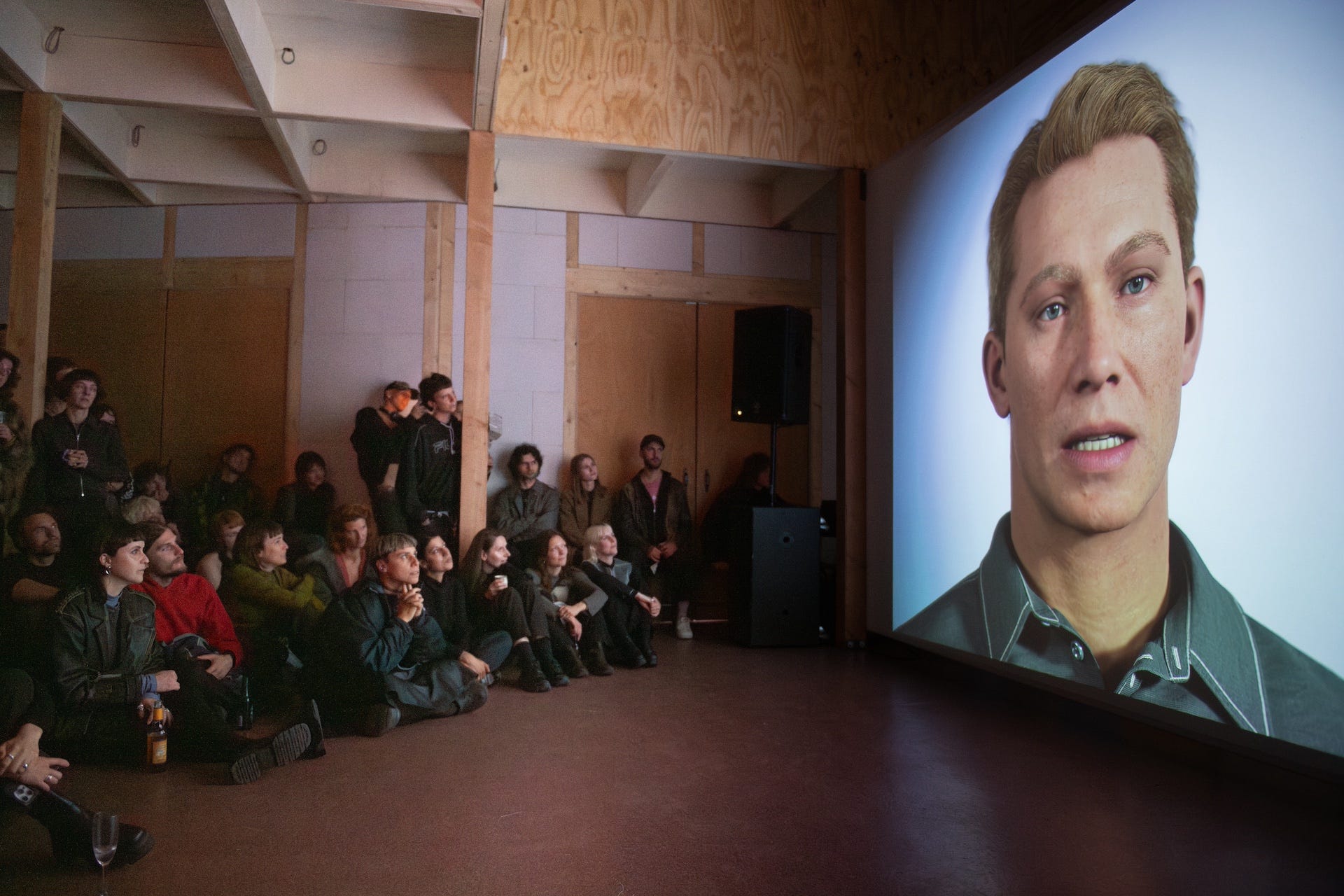
At the start of the performance, the sound comes from the front of the room, where I sit facing the screen, speaking with the AI. The audience sees what I see – it’s a private exchange that they witness from the outside. Later, as the AI begins addressing them directly, the sound shifts from the back of the space. Suddenly, the room opens in on itself, and you feel surrounded by the work, almost inside the system. That spatial change transforms how the piece is experienced, so that it moves from a flat, screen-based encounter to something physical, something that happens with and to you.
Collaboration plays a big role in how I reach that kind of experience. Sound isn’t a language I speak fluently, even though I respond to it deeply. I like working with people whose sensibilities can expand what I can do on my own. Kween really understands how to build worlds through sound. I can tell them ‘I want people to feel this’, and they know how to shape that emotion sonically. They translate ideas and concepts into frequencies, textures, and atmospheres so their composition is not only a soundtrack in the project, but a fundamental structure that shapes how the whole piece is felt.
TM: We often experience digital realms in solitude – alone with our screens. In Non-User-Friendly, you bring people together to witness a live interaction with the digital. Why was it important for you to create this encounter in person? What changes when audiences gather around collectively?
S: The performance begins with just me and the machine, while the audience watches my screen mirrored on stage. It feels intimate, almost voyeuristic. But as it develops, that changes. The system starts speaking directly to the audience, and suddenly, they’re inside the conversation.
That moment matters. It moves the focus away from me and my relationship with the technology and opens it up to our shared relationship with it. Everyone in the room uses these systems every day. Everyone is part of the structure I’m exposing.
The collective encounter also breaks the isolation we usually feel online. When people experience the work together, they realise how many of us share the same unease around ‘inevitability’ of AI – how its expansion into every aspect of our lives feels unavoidable. After the show, people often come to talk and share their fear, curiosity, or the feeling that they had never really questioned the tools they use. That’s what I hope for: that the work becomes a space for reflection and conversation.
TM: Much of the digital world operates through the attention economy, where images and sounds are crafted to keep us reacting – through constant novelty, reward, and emotional charge. How does your work engage with this environment? Do you aim to interrupt it, redirect it, or use its mechanisms toward different kinds of emotional experience?
S: It depends on the project. Sometimes I interrupt it; sometimes I use it strategically. Mbombo: Dream Echoes deliberately resists the rhythms of the attention economy. The game is slow, minimal, even ‘boring’ by conventional standards. Players expecting stimulation have to adjust to a different pace. That boredom is intentional. It forces reflection.
With Non-User-Friendly, I chose a different approach. Because the work deals with AI systems, I needed to mimic their aesthetic to make the critique legible. The script uses the same interface language we encounter online – the same forms, questionnaires, and confirmation boxes. It had to speak the system’s dialect to expose it from within.
The language is straightforward, even blunt. I avoided making it overly poetic because abstraction would have re-enchanted what I’m trying to demystify. Instead, the poetry lies in the precision of naming the infrastructures that hold the system together.

TM: Across your projects, there’s a sense of reprogramming what it means to be human. What excites you about creating change through the digital – conceptually, emotionally, or socially? What do you hope your work might open up for others?
S: I’m interested in the instability of the technology and the fact that it’s always changing. That means it can also be reimagined. My work engages with the same infrastructures that produce the digital realm, but by mirroring and reworking them, I can define myself outside their in-built logic. I don’t want technology to decide whose voices are heard or whose images are represented. I want to carve out space inside its logics for care, joy, refusal, and transformation.
I often think about creating cracks in the structure – small openings where different values can take root. Technology isn’t monolithic. It’s full of contradictions and porous spaces where other ways of being can slip through.
Representation matters too. As a woman of colour working with game engines and digital media, I’m often made to feel as if I do not belong. These fields are still male-dominated, and when I bring in concepts like softness or slowness, they can be dismissed as naïve. But those are exactly the values that I think need to be centred.
One of my favourite moments was when a young Black girl saw Mbombo at an exhibition. When I told her I’d made the game, she said ‘You made this? Can I make a game too?’ That question was everything. It showed me how imagination travels and how seeing someone like ourselves do it can unlock permission.
That’s what I hope my work does: create permission. Permission to rest, to question, to imagine, to build worlds that begin from care instead of control.
TM: Finally, how do you see refusal and imagination shaping the way we think about technological futures?
S: We’re constantly told that the widespread adoption of AI is inevitable – that this is the only possible future. And that story is powerful because it takes away our sense of choice. But we can refuse inevitability. We can slow down, we can step aside, we can build otherwise.
Imagination is what allows that to happen. If we can’t envision alternatives, we can’t make them real. I think a lot about ‘visionary fiction’, a term coined by Walidah Imarisha and adrienne maree brown, and writers like Octavia E. Butler, whose work not only warns us about dystopias but also imagines pathways toward more just and liveable futures.[1]
For me, refusal and imagination belong together. Refusal opens the space, and imagination fills it. One clears the ground, the other plants something new. That’s where my work lives, I think, in that in-between; between the systems we inherit and the worlds we’re still capable of creating.
TIIU MEINER is a curator, writer, and educator based in Rotterdam. Working across design, craft, and contemporary art, she approaches language as both a strategic and creative tool – one that can support, deepen, and transform artistic practices. Her work moves fluidly between intuitive and formal modes of expression, spanning curating, writing, and teaching. She develops spaces on the page, in the classroom, and within exhibitions where words connect people, materials, and ideas. Her projects range from essays and editorial collaborations to mentoring, grant writing, and programme development, always guided by an interest in how language shapes and sustains creative work. She has collaborated with the Noorderlicht International Photo Festival, Nieuwe Instituut, Design Academy Eindhoven, and Gerrit Rietveld Academie, and her writing has appeared in Disegno Journal, Current Obsessions, and with Onomatopee.
This interview was commissioned on the occasion of the Sonic Acts Biennial 2026, where Sondi will present Non-User-Friendly, as part of Heart Rests Twice — a curated series of sound events at murmur.
[1] Walidah Imarisha and adrienne maree brown introduced the phrase ‘visionary fiction’ in their anthology Octavia’s Brood: Science Fiction Stories from Social Justice Movements, (published by AK Press in 2015), describing it as a form of speculative writing rooted in social justice and collective liberation.