

Collective Reading and the Making of Meaning in Encounter
Ahead of the upcoming Slow Reading Club, a collective reading session hosted by Sonic Acts, this article reflects on the collective dimensions of reading, listening, and meaning-making.

Organised as part of the Sonic Acts Archive projects, the Slow Reading Club on 6 June at Salon de IJzerstaven (20:00–22:30) invites participants into an immersive late-night environment where texts, poetry, repetition, and voice converge into a shared, embodied experience. Leading up to the event, this article reflects on text, reading, and meaning within the context of Slow Reading Club (SRC) and their practice; how their invitation by Sonic Acts aligns with evolving approaches to archival practice; and includes the article Two Hundred Years of Total Conversion by Sasha Litvintseva and Beny Wagner, originally published in Sonic Acts’ Ecoes #6 (2024), selected by SRC as part of a curated collection drawn for the reader accompanying the event.
→ Read more and buy your ticket here
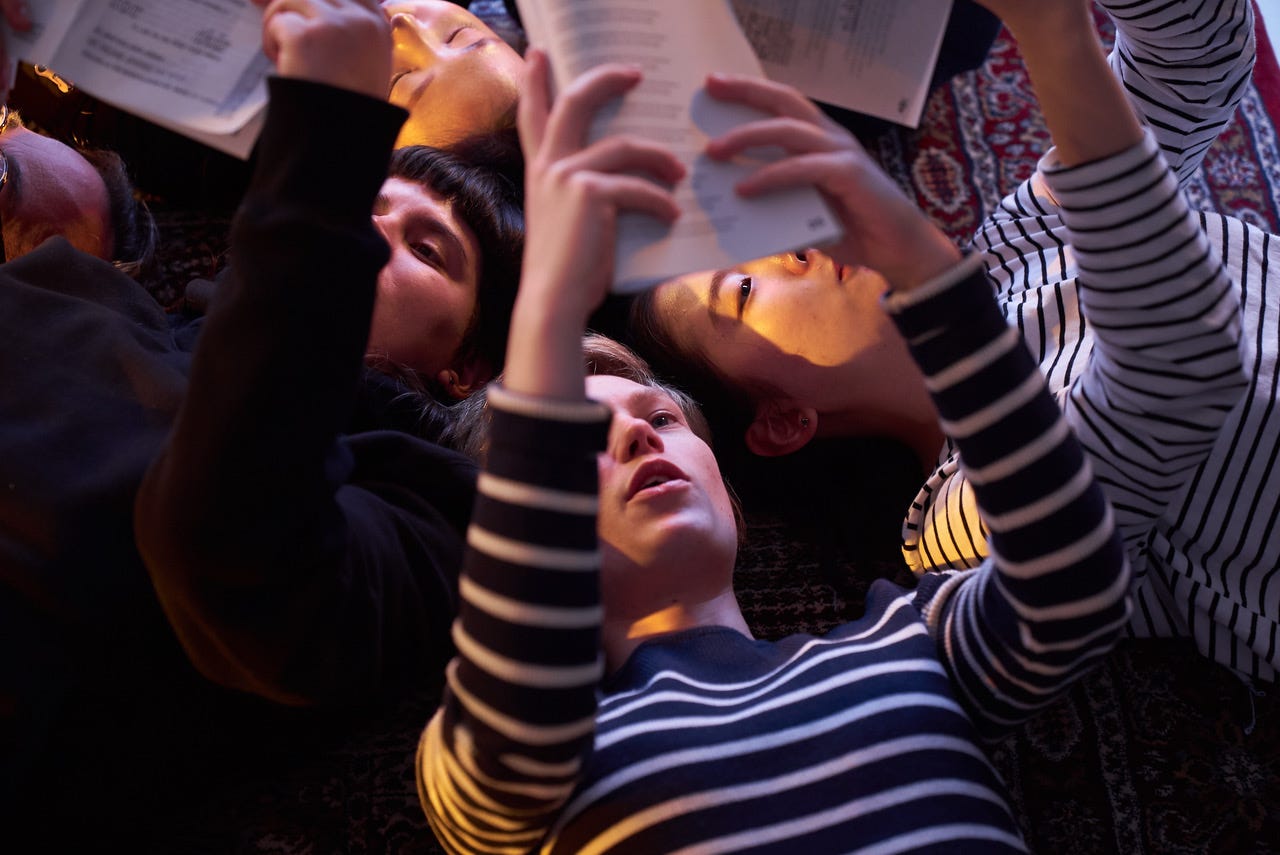
Lost in translation, in bedlams of language, in senseless misalignments – how does reading so often become a site of misunderstanding rather than clarity? A single text can scatter into a multitude of readings, pulled in different directions, shaped and reshaped by context, tone, and proximity. Meaning slips, multiplies, and drifts, like a game of telephone that never quite returns to its origin. If this flux is already present in reading itself, what happens when we embrace it fully? What shifts when books, libraries, and archives – usually framed as repositories of static knowledge – are understood instead as living bodies, continuously negotiated through each encounter? What might these texts reveal when we engage with them, differently?
For Slow Reading Club (SRC), these questions sit at the core of its practice. Founded in 2016 by Bryana Fritz and Henry Andersen, SRC approaches text and its meaning as something that is never fixed or static, but instead continuously produced through bodies, contexts, and situations – turning reading into a commons where meaning shifts with each encounter. Over the past decade, SRC has organised a series of collective reading sessions across project spaces and cultural institutions, where texts drawn from institutional archives, libraries, and/or their own collections become the basis for reading scores. Read through shifting rhythms of speaking, listening, pause, movement, repetition, and embodiment, these gatherings intuitively echo the ever-changing nature of meaning in text, where interpretation is continuously negotiated in real time.
SRC’s practice offers a particular way of engaging with text, making it a fitting approach for working with archival material that spans different historical and institutional contexts. For the Sonic Acts iteration of Slow Reading Club, the artists were invited to go through the Sonic Acts Press archive and select a series of texts from over twenty-five years of publications, forming the basis of a reading used during the event. The project takes place within the broader context of Sonic Acts’ Archive projects, which encompasses the collecting, digitising, and organising of materials, while also functioning as a sustained inquiry into what an archive is – and what it could be – for an organisation with more than thirty years of activity. Rather than operating as a neutral repository, it treats institutional memory as something actively produced: a living resource shaped by decisions of inclusion, forms of access, and the ways materials are re-encountered over time. SRC’s contribution brings these institutional texts back into circulation as material for prompts for collective interaction rather than objects of analysis.
The selected writings reinforce this approach through recurring questions around collectivity and shared forms of authorship. Works such as The Unfolding of Life in a Spiral (2019) by The Living and the Dead Ensemble, Sentences about River and Cancers (2022) by Luke Fischbeck, and Cancer is a Weather System (2022) by Sarah Rara (both part of an artist collective lucky dragons) approach language as something distributed across bodies, systems, and environments rather than contained within a singular perspective. Sasha Litvintseva and Beny Wagner’s Two Hundred Years of Total Conversion (2024) similarly reflects on transformation across historical and material scales, while texts from the Slow Reading Club archive – including, among others, Catherine Christer Hennix’s Degrees of Unsolvability (1976–1979) – stretch language toward repetition, fragmentation, and abstraction.
Read collectively, the texts form a temporary topos produced in the moment. The late-night setting of the event reinforces reading as a lived, embodied practice – shaped by yellow light, drinks, proximity, and shifting constellations of voices, in an atmosphere closer to choreography or ritual than literary discussion. Participants negotiate language physically as much as intellectually, through breath, timing, attention, and distance to others. Here, reading becomes relational, revealing how interpretation is always shaped by collective conditions: who speaks, who listens, how voices align, and where they break apart in changing constellations of encounter and ongoing production.
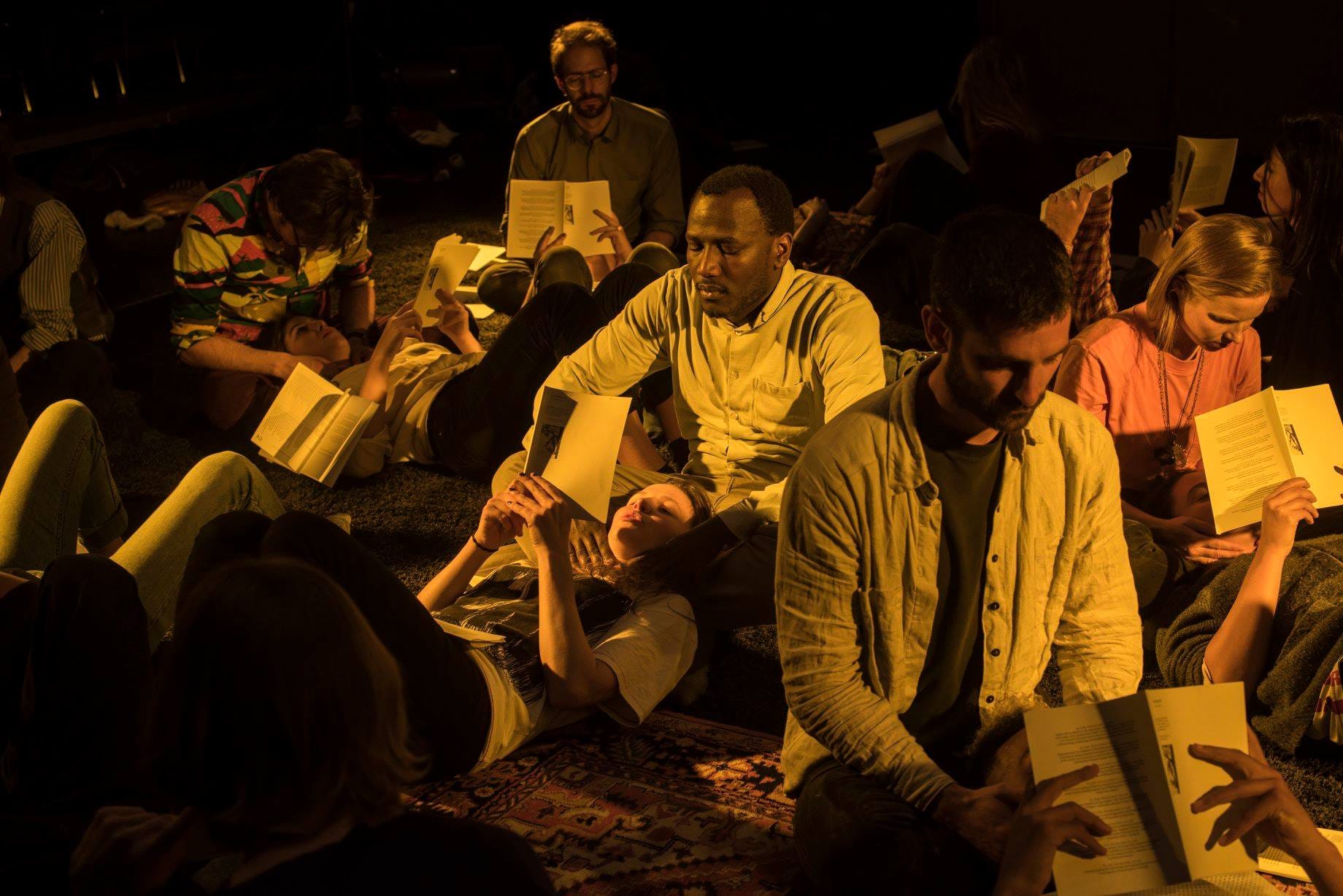
Founded in Brussels in 2016 by Bryana Fritz (USA) and Henry Andersen (AUS), Slow Reading Club creates situations for collective reading that probe and interrupt conventional notions of readership. By shaping who reads, when, and in relation to whom, the project foregrounds how meaning emerges through social, embodied, and temporal dynamics. Since premiering at Kunstenfestivaldesarts in 2017, Slow Reading Club has presented work internationally at venues including MAK Schindler House in Los Angeles, WIELS, Bergen Kunsthall, Lafayette Anticipations, Cabaret Voltaire in Zurich, Centre Pompidou, Dortmunder Kunstverein, and ZKM Karlsruhe.
Included in this entry is the article Two Hundred Years of Total Conversion by Sasha Litvintseva and Beny Wagner, originally published in Sonic Acts’ Ecoes #6 (2024). The text was selected by artists Bryana Fritz and Henry Andersen (SRC) as part of a curated collection drawn from the Sonic Acts Press archive for the reader accompanying this iteration of Slow Reading Club.
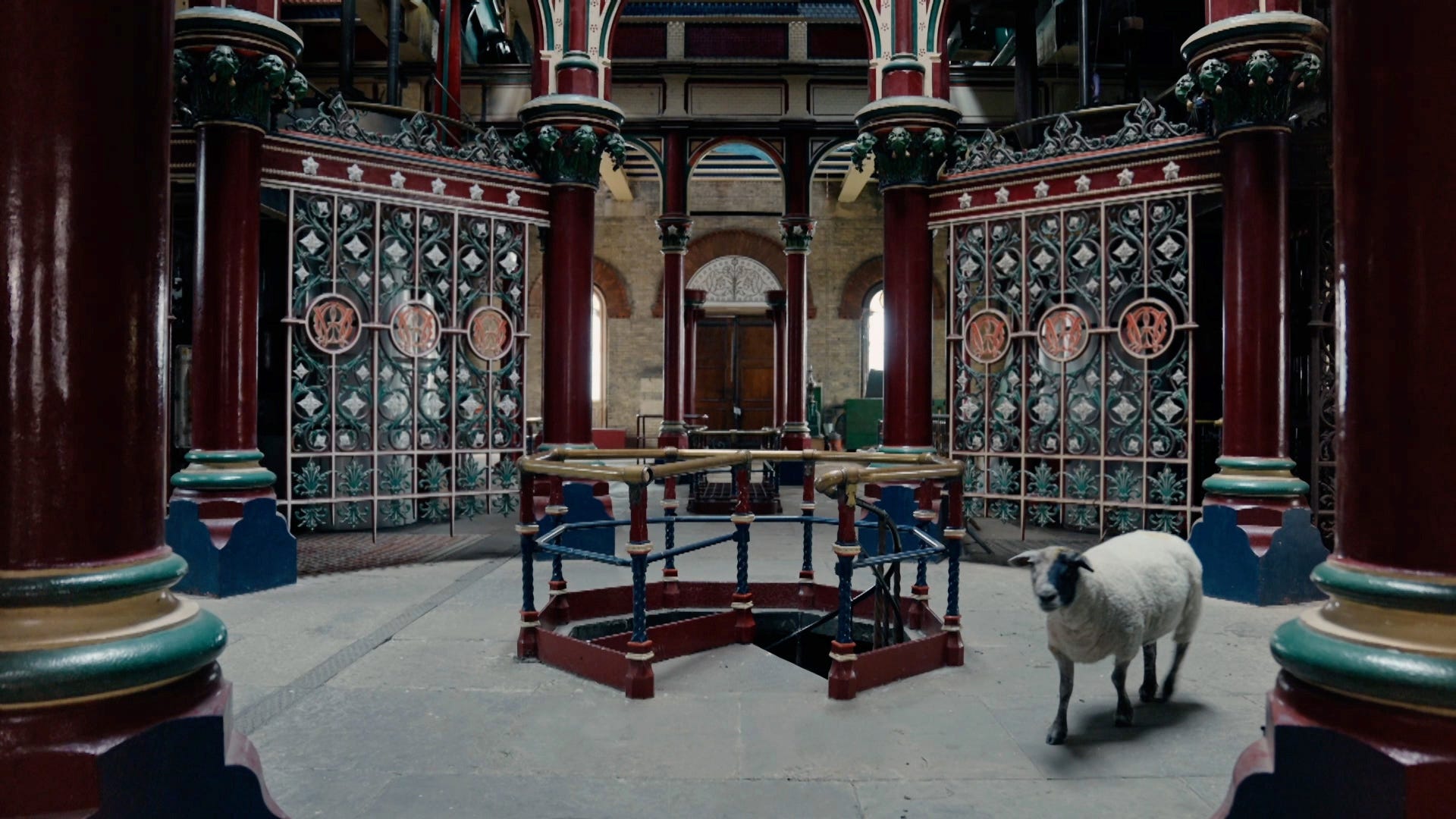
Two Hundred Years of Total Conversion (2024)
Sasha Litvintseva and Beny Wagner
Originally published in Ecoes #6 magazine by Sonic Acts Press.
During the second half of the nineteenth century, the French physiologist Claude Bernard dedicated much of his life’s work to establishing a scientific basis for the problem of digestion. What happens, he asked, when one organism eats another? Applying the scientific method, which is to say, by severing the part from the whole, Bernard experimented with observing mutton as it passed through a dog’s digesting body. Did the dog’s own flesh become more like the lamb it had ingested, or, rather, did the lamb turn into the dog?
Bernard proved that the dog, and by extension the human, breaks down the substance it eats into chemical components, and from these components builds new molecules. The chemicals, in Bernard’s model, lose all connection to their origin, for example the mutton, and become anonymous indistinct building blocks for the eater to build its own body. A dog eating mutton doesn’t store mutton fat, he explained, it stores dog fat. Upending the belief that we are what we eat, Bernard’s model of the world stipulates that what you eat becomes you.
This model of digestion had profound philosophical and ethical implications. For Bernard, the absolute metabolic annihilation of one organism by the other was the very condition of the eater’s freedom. The nineteenth century hierarchy of living things formalised the linear food chain, where an organism’s freedom was commensurate with their position in the hierarchy and their ability to successfully dissolve the organisms below them into the stuff of their own bodies. Historian of science Hannah Landecker calls this the model of total conversion, whereby the eater turns the environment into itself, gaining greater degrees of freedom through greater degrees of independence from the environment.
Bernard’s vision of digestion continues to haunt us in the form of common sense. This common sense, in turn, is haunted by a model of empire in which those at the top of the food chain can endlessly incorporate the spoils of environments near and far without any fear of changing the stability of their position at the top. Bernard’s vision of freedom sides with the omnivorous glutton who need not care about the potential for the things it eats to affect anything about its total autonomy and therefore sovereignty.
***
Bernard’s concept of total conversion resonates strongly with one particular colonial expedition, undertaken a century before his ideas transformed Western science regarding digestion.
In early 1780, a British colonial battalion was sent to the San Juan river in Nicaragua with the mission to cut the Spanish Empire in half and connect the Atlantic and Pacific oceans for British trade routes.1 Stationed in the middle of the rainforest, the battalion of two thousand soldiers was surrounded by an abundance of fruit and wild game. Yet strict martial law forbade them from eating anything found in the environment. Within the military it was believed that hunting and foraging would encourage the kind of self-reliance that would inevitably lead to desertion. They had been sent to conquer this place, not to become part of it, and so, they were allowed only the meagre provisions they had brought with them: gruel, which was soon in short supply.
Their situation became dire when the rainy season began in April and illness began spreading among the soldiers in the camp. Still forbidden to break with the self-imposed famine, the effects of their illnesses were compounded by severe malnutrition. By June, those soldiers who hadn’t died or deserted were too weak to crawl, too sick to bury the dead, which soon outnumbered the living.
We know about the details of this expedition through the testimony of Colonel Edward Marcus Despard, a born Irishman who joined the British army at age fifteen and rose through the ranks while stationed in Jamaica. As the commander of the expedition, he experienced first-hand the arbitrary brutality that had caused almost all of the two thousand soldiers in his battalion to starve to death. His own life was spared thanks to the indigenous Miskito people who took pity on him and the hundred or so other survivors, nursing them back to health through their knowledge of the tropical commons.
The official reports of the catastrophe, written by the British governor of Jamaica, celebrated the surviving soldiers for the strength of their discipline, which he took as proof of their superiority over the indigenous peoples. Disillusioned with the arrogant pretences that fed the British imperial mythology, Despard became politicised. Ten years later, in the spring of 1790, he returned to London with his wife Catherine Despard, an African American woman, and their child. Over the next decade, they worked tirelessly in support of common laborers, soldiers, and sailors, and all other people dispossessed by the government. For this they were repeatedly put in jail. In November 1802, Despard was arrested along with 40 other workingmen, accused of organising a revolutionary army whose goal was to seize power in London and declare a republic. Three months later, in February 1803, Despard was executed in front of a crowd of twenty thousand people.
***
European colonial expansion is often depicted as an insatiable, ever- expanding kind of devouring. What struck us about this expedition was a story of enforced starvation at the frontier. We might call this the fear of becoming indistinguishable from the environment, a kind of premodern, prescientific form of superstition about losing one’s own identity. There is of course no reason to assume this story is in any way causally connected to Bernard’s scientific model of digestion. Yet, once Bernard’s model of total conversion turns the fear of becoming what you eat into superstition, a new kind of resource extraction from the periphery to the centre is free to grow unimpeded. Bernard tells us that once the environment enters the consuming organism, it loses all meaningful relationship to the outside. The unstable negotiation of interior and exterior that is perpetually reenacted through digestion is reduced to a mere chemical exchange, a material process devoid of context, divested from the complexities of exchange and transformation. From the reciprocity of digestion, we move to the force of consumption, which, in Eugenie Brinkema’s words, is a violence that
takes in, absorbs, exhausts; it devastates some resource. This is the violence of burning and dissipation, draining and squandering, to bleed or milk or just suck dry; from the Latin consumptio and consumere, ‘to use up, eat, waste’.2
The model of total conversion abstracted digestion from the embodied lives of organisms to the depersonalised, perhaps even dematerialised, materialism of western science. But Bernard’s actual experimental framework was a deeply embodied messy business. His primary research method, for which he became Europe’s foremost advocate, was vivisection: the dissection of a live animal. After several months of assisting Bernard, the physician George Hoggan, horrified by what he had witnessed in Bernard’s lab, wrote that he was ‘prepared to see not only science, but even mankind, perish rather than have recourse to such means of saving it.’3 In 1868, Bernard’s wife and daughters returned home to find that the family dog had been vivisected. We might imagine that this was the same dog who had converted the lamb fat into its own. After divorcing him a year later in 1870, Marie Françoise Bernard became a lifelong anti-vivisection campaigner, contributing to the first Cruelty to Animals Act of 1876.4 Seemingly unperturbed by the responses, Bernard wrote:
[T]he physiologist is no ordinary man. He is a learned man, a man possessed and absorbed by a scientific idea. He does not hear the animals’ cries of pain. He is blind to the blood that flows. He sees nothing but his idea, and organisms which conceal from him the secrets he is resolved to discover.5
The ends justify the means, results justify the carnage. This is true to Bernard’s method, as it is to his model of digestion, as it is to the model and methods of empire.
***
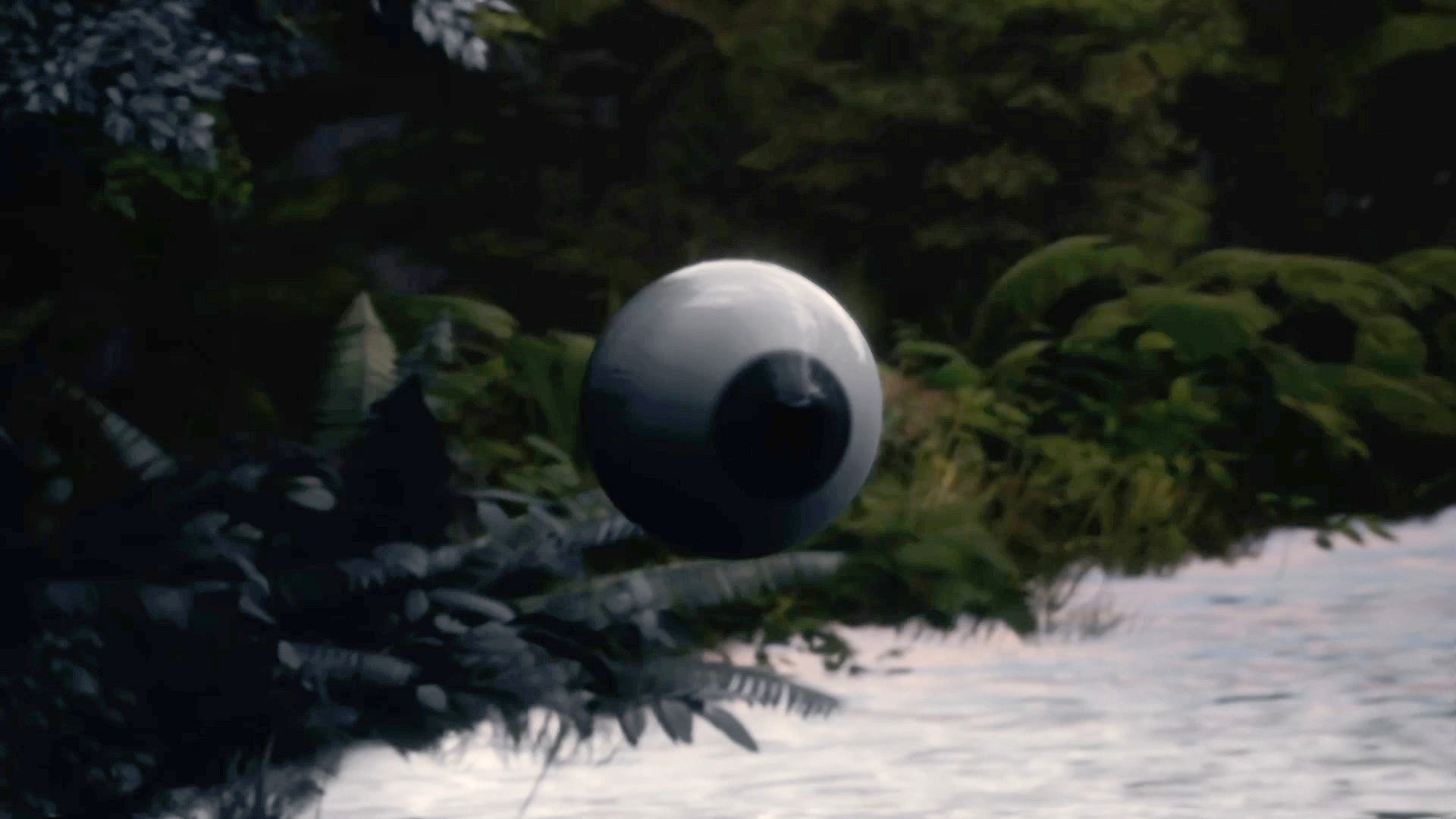
The violent abstraction of the ‘scientific idea’ of total conversion that possessed and absorbed Bernard and much of modern Western science is historically contained. We might say that it existed for roughly two hundred years: it is bracketed on one end by the failed Nicaragua expedition around 1780, and on the other end, by the science fiction character of Anyanwu, brought to life by Octavia Butler in her novel Wild Seed in 1980. Anyanwu is a shapeshifter and a healer who can take on any human form – male, female, elderly, or child – and heal herself and others, reconstituting limbs and organs.6 But she is also able to become any other animal. She undergoes this process of metamorphosis by digesting small pieces of the animal’s flesh:
[T]he flesh told her all she needed to know about the creature’s physical structure – all she needed to know to take its shape and live as it did. Just a small amount of raw flesh told her more than she had words to say. Within each bite, the creature told her its story clearly thousands of times.7
Anyanwu’s digestion is a kind of communication, a transformative receptivity, an act of listening and absorption.
A keen student of developments in the life sciences, Butler incorporated and extended insights from the cutting edge of science into the bodies and philosophies of the characters that populate her novels. Anyanwu is a character whose own being derives from the multiplicity of other beings it contains. This model of a character who, rather than absorbing otherness into a singular sovereign body, acts as a node of constant transformation, was prophetic when read through the lens of contemporary developments in the science of nutrition and the ever-increasing focus on epigenetics, the microbiome, the holobiont, and the hologenome. We could say that Anyanwu understands those she eats on a genetic level, sequencing the data necessary to reconstitute the whole organism.
In 2011, a group of molecular biologists at Nanjing University, China, ran a series of experiments that to their great surprise discovered genetic material belonging to rice in the liver of mice.8 The plant RNA entered the bloodstream and tissues of the animals that consumed it and from there participated ‘in regulating mouse genes that code for proteins involved in blood lipid regulation’.9 Long after it had been consumed, the rice was active in the mouse’s body. More than that, the rice DNA entered the genetic structure of the animal host in such a way that it passed this regulatory information onto its offspring, meaning that future generations of mice would have rice DNA fragments participating in their lipid regulation, without ever having consumed rice themselves.
Another set of experiments conducted by systems biologists had shown that much of the RNA circulating in human blood plasma was not human, but belonged to food sources such as fungi, yeast, corn, rice, tomato, soybeans, and grapes. This foreign generic material was found to participate in regulating human genes and bodily processes. The eaten, in this sense, does not simply disintegrate into the nutrients and energy needed to run the eater’s body, rather it actively participates in the running ‘the operation of being a body’.10 We are still only at the cusp of understanding how ‘foreign’ genetic material runs ‘our’ bodies,but it is already clear that Bernard’s model of total conversion has been demoted from its status as science, to that of science fiction.
Butler writes beautifully of Anyanwu’s transformations into other animals: ‘[S]he had watched eagles fly until she could no longer stand to only watch. She had killed an eagle and eaten and learned and flown as no human was ever meant to fly.’11 Anyanwu does not dissolve the material she eats into inert, anonymous matter. Digestion for her is a process of communication, exchange, becoming. Butler continues: ‘[S]he had flown away, escaping her town, her duties, her kinsmen. [...] She would fly. There was danger. Men hunted her and once had nearly killed her. [...] But fear never kept her out of the sky.’12 What is immediately striking about this model of digestion, is the emphasis on a freedom attained through transformation. The plasticity of her body, achieved through consuming other beings, affords Anyanwu the ability to transcend oppression and limitation.
In Bernard’s model of total conversion, the precondition for freedom is the annihilation of difference into the homogenising body. This is a body that expands by creating ever greater deposits of its own fat, but which, in the same stroke, is denied the possibility of change. Turning the environment and everything in it into a standing reserve, the eater itself becomes condemned to mechanically predetermined operationality. Anyanwu presents an alternative model of digestion where freedom is attained through complete metamorphosis: freedom is the total submission to change.
Sasha Litvintseva and Beny Wagner are artists, filmmakers, and writers working collaboratively since 2018. Focusing on moving image as a tool for the active production of new worlds, their practice has been driven by questions about the thresholds between the body and its surroundings, knowledge regimes and power, modes of organising and perceiving the natural world. Their collaborative work has been presented globally, including at the Berlinale, Rotterdam, CPH:DOX, Courtisane film festivals, Tate Modern, CAC Vilnius, Los Angeles Filmforum, Museum of the Moving Image NY, Transmediale, Sonic Acts, Berlin Atonal, Ars Electronica festivals, Seoul Mediacity Biennale, Taiwan Video Art Exhibition, and was featured on the Criterion Channel. Their films have won numerous awards including the Silvestre Best Short Film at IndieLisboa and Best Short Documentary at Guanajuato Film Festival. Beny Wagner is currently a PhD candidate at the Archaeologies of Media and Technology Research Group at Winchester School of Art and a lecturer in film at UCL. Sasha Litvintseva is a senior lecturer in film at Queen Mary University of London, and holds a PhD in Media, Communications and Cultural Studies from Goldsmiths.
Litvintseva and Wagner are also the authors of All Thoughts Fly: Monster, Taxonomy, Film, published by Sonic Acts Press in 2021. This publication is still available in the Sonic Acts webshop.
The historical detail of this expedition and Edward Despard’s life are from Peter Linebaugh and Marcus Rediker, The Many-Headed Hydra: The Hidden History of the Revolutionary Atlantic (London and New York: Verso, 2000).
Eugenie Brinkema, Life-Destroying Diagrams (Durham and London: Duke University Press, 2022), p. 193.
George Hoggan, ‘Letter’, Morning Post (2 February 1875), np.
Mary Midgley, Animals and Why They Matter (Athens, Georgia: University of Georgia Press, 1998), p. 28.
Claude Bernard quoted in Rod Preece, Awe for the Tiger, Love for the Lamb: A Chronicle of Sensibility to Animals (Vancouver: University of British Columbia Press, 2002), p. 309.
Octavia E. Butler, Wild Seed (London: Headline Publishing Group, 2020).
Ibid., p. 85.
The detail of this and the following experiment are from Hannah Landecker, ‘Metabolism, Reproduction, and the Aftermath of Categories’, in The Scholar and Feminist Online, 11:3 (2013), https://sfonline.barnard.edu/life-un-ltd-feminism-bioscience-race/metabolism-reproduction-and-the-aftermath-of-categories/.
Ibid., np.
Ibid.
Octavia E. Butler, Wild Seed (London: Headline Publishing Group, 2020), p. 87.
Ibid.